
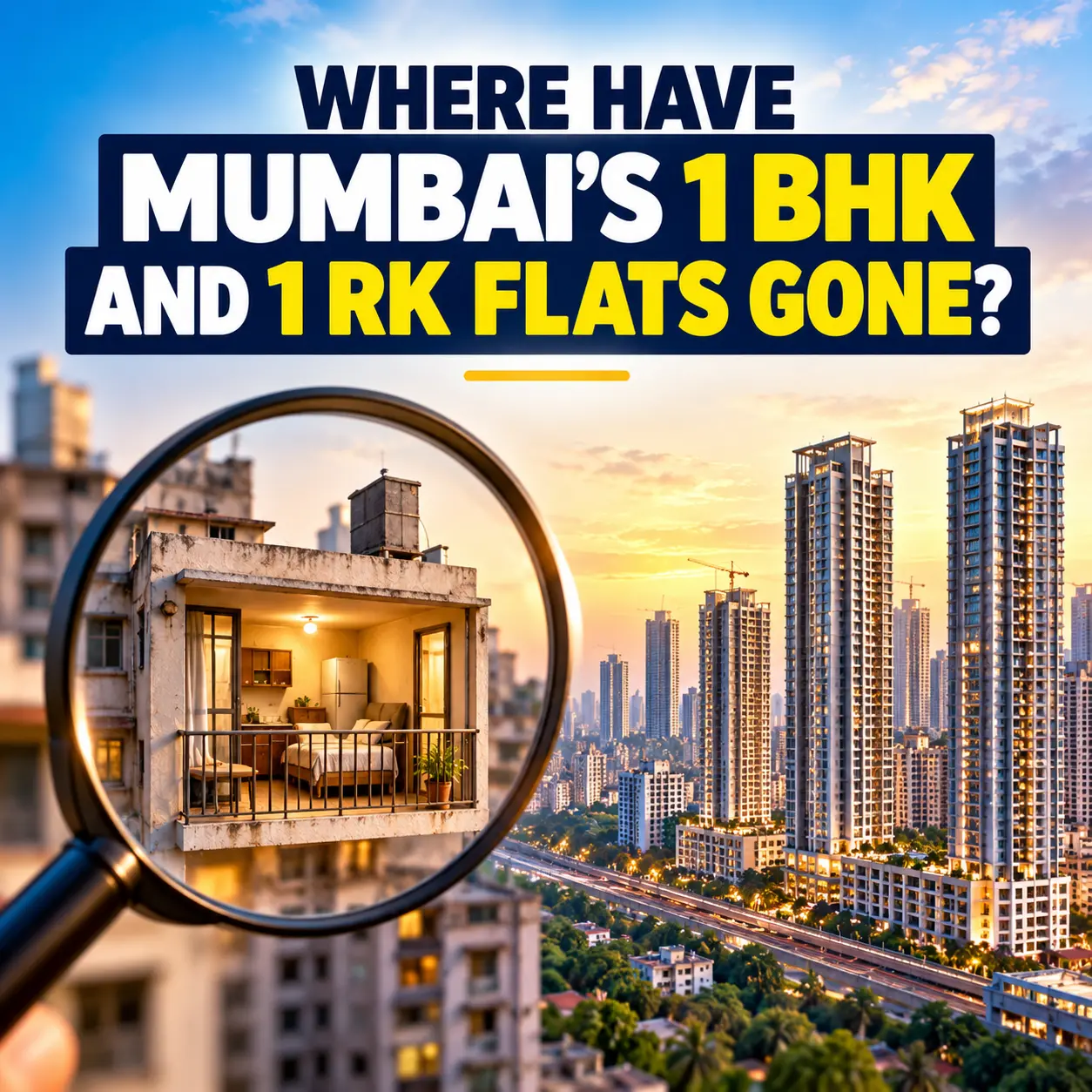
Where Have Mumbai’s 1 BHK and 1 RK Flats Gone? Why Affordable Homes Are Becoming Harder to Find in 2026 By Shine Properties | Your Real Estate Consultant in Mira Road

Where Have Mumbai’s 1 BHK and 1 RK Flats Gone? Why Affordable Homes Are Becoming Harder to Find in 2026
By Shine Properties | Your Real Estate Consultant in Mira Road
Introduction: Is Mumbai Building Homes That Ordinary Buyers Can Afford?
For generations, owning a home in Mumbai has been a dream for millions of middle-class families. For a young professional, a newly married couple or a family moving from a rented room, a compact 1 RK or 1 BHK flat was often the first step towards owning a home of their own.
It may not have been spacious. It may not have had a swimming pool, a gym or a landscaped garden. But it offered something invaluable: an affordable entry into the property market.
Today, however, many aspiring homebuyers are asking a difficult question:
Why does it seem increasingly difficult to find a reasonably priced 1 RK or 1 BHK flat in a new residential project across Mumbai and its suburbs?
Walk through the brochures of many newly launched residential projects and you will frequently see 2 BHK, 3 BHK and premium apartments promoted alongside lifestyle amenities. Smaller homes still exist, but finding one that fits a middle-class family's budget, preferred location and space requirements can be challenging.
Is this perception supported by market data? Why are developers focusing on larger homes? And what does this mean for the average salaried buyer?
Let's examine the changing face of Mumbai's housing market.
Index
- The changing reality of Mumbai's housing market
- What does the latest market data tell us?
- Why are developers building more 2 BHK and larger homes?
- The economics behind a 1 BHK flat
- How the middle class is being affected
- Are buyers being pushed towards the outskirts?
- Is a 1 BHK still a sensible first home?
- What can developers and policymakers do?
- What should homebuyers do in 2026?
- Frequently Asked Questions
- How Shine Properties can help
1. The Changing Reality of Mumbai's Housing Market
Mumbai's housing market is not simply moving towards larger homes. It is also becoming more expensive to enter, particularly for buyers who depend on regular salaries and home loans.
A buyer earning ₹50,000 to ₹80,000 per month may be able to manage a modest home loan, depending on existing obligations, savings and eligibility. However, when even a compact apartment requires a substantial down payment and a sizeable monthly EMI, homeownership can become difficult.
The problem is not necessarily that every developer has stopped building small flats. The bigger concern is that the supply of homes at prices ordinary buyers can afford may not be keeping pace with their needs.
A 1 BHK priced beyond a buyer's budget is not an affordable option simply because it has one bedroom.
This distinction is important. Housing affordability depends on the price, the carpet area, the location, the down payment, loan eligibility and the buyer's monthly household expenses.
2. What Does the Latest Market Data Tell Us?
Recent market reporting supports the concern that smaller and affordable homes are facing pressure, although the picture varies by location, price range and type of development.
A report published by Mid-Day in 2026 highlighted the declining relative importance of 1 BHK homes in Mumbai's new residential supply. It cited rising land and construction costs, government levies and developers' preference for higher-value homes among the factors behind the change.
Source: Mid-Day — Mumbai's vanishing 1 BHKs
Another useful indicator is the configuration mix in new launches. A Mumbai market data report covering January to June 2026 recorded 9,650 1 BHK units out of 39,795 new launches, or approximately 24%. Studio and 1 RK units accounted for around 1%.
Source: Mumbai Real Estate Data Handbook, July 2026
These figures should be interpreted carefully: they refer to the report's defined market and period, not every residential project across the entire Mumbai Metropolitan Region. The number of new launches also does not tell us how many units are currently available for purchase.
Nevertheless, the figures raise a legitimate question: are enough compact homes being built for first-time buyers?
The answer cannot be judged by the skyline alone. We need to look at the supply of homes at different price points and compare it with what buyers can realistically afford.
3. Why Are Developers Building More 2 BHK and Larger Homes?
There is no single reason. Several economic and market forces influence developers' decisions.
A. Land prices are high
Land is one of the largest costs in Mumbai real estate. In established neighbourhoods, redevelopment and land acquisition can be expensive.
A developer must recover land costs, construction expenses, finance costs, approvals, taxes and other project expenses. If the final selling price of a compact flat is too low to make the project financially viable, the developer may prefer a different mix of apartment sizes or a higher-priced location strategy.
B. Larger homes generate higher revenue per unit
Consider two hypothetical apartments in the same development:
- A compact 1 BHK priced at ₹55 lakh.
- A 2 BHK priced at ₹95 lakh.
The second apartment generates considerably more revenue per sale. Its construction cost will also be higher because it requires more area and materials, so the difference in selling price is not equal to profit. Still, larger apartments can offer a more attractive commercial proposition in certain projects.
The actual economics depend on the land cost, carpet area, selling rate, construction design and project obligations.
C. Redevelopment is changing the housing mix
Redevelopment is an important source of new residential supply in Mumbai. Older buildings are replaced with modern developments, often with additional amenities and updated layouts.
But redevelopment must also account for existing residents, rehabilitation requirements, landowners and project financing. These obligations can influence the number, size and selling price of the apartments available to new buyers.
In some projects, the economics may encourage a greater focus on larger or premium homes.
D. Buyers' expectations have changed
Many buyers now seek a separate work-from-home space, additional storage, a larger kitchen, parking and shared amenities. Some families who might once have considered a 1 BHK now prefer a 2 BHK.
Developers respond to this demand, particularly when customers are willing and able to pay for additional space.
However, not every buyer wants or can afford a larger apartment. The challenge is to serve both customers who want spacious homes and those who need an affordable first home.
E. Construction and regulatory costs matter
Construction materials, labour, financing, approvals, premiums and other charges affect the final price of a home. These expenses differ across locations and projects.
When costs rise, a developer may find it difficult to offer a compact apartment at a genuinely affordable total price without changing the project's economics.
The result can be a gap between the price at which a homebuyer needs a flat to be sold and the price at which a developer can viably build and sell it.
4. The Economics Behind a 1 BHK Flat
Imagine a young couple working in Mumbai. Together, they earn ₹90,000 per month. They want a modest 1 BHK close enough to work to avoid exhausting daily travel.
Their priorities are simple:
- A manageable home loan EMI.
- A safe neighbourhood.
- Reasonable access to public transport.
- A home they can maintain without sacrificing all their savings.
- Enough space for their needs today, with some flexibility for the future.
Now imagine that the available new apartments in their preferred neighbourhood mostly exceed their budget.
They face three difficult choices: stretch their finances to buy a bigger home, move farther away from work, or continue renting.
This is where the shortage of affordable entry-level homes becomes a wider social and economic issue.
The challenge is not only the number of bedrooms being built. It is whether the total purchase price matches the income of the people who need the home.
5. How Is This Affecting Middle-Class Homebuyers?
First-time buyers are delaying ownership
A first home is often purchased after years of saving. When suitable homes become more expensive, buyers may need a larger down payment and a longer loan tenure.
Some postpone the purchase, while others continue renting because buying would leave too little money for emergencies and everyday expenses.
Young couples face difficult trade-offs
A 1 BHK may be enough for a couple today, but they may eventually need another room. A 2 BHK offers more flexibility, but the additional cost can make it unaffordable.
The buyer is left choosing between what is affordable now and what might be suitable in the future.
Families may move farther from work
To find a lower-priced property, buyers often explore outer suburbs and emerging residential areas.
A lower purchase price can help, but the household must also consider transport costs, commuting time, childcare, schools, healthcare and access to employment.
A cheaper flat is not necessarily the cheaper lifestyle if travel consumes several hours each day.
More households remain dependent on rentals
When purchasing a home becomes difficult, renting may be the practical alternative.
Renting is not inherently a poor financial decision. It can offer flexibility and avoid the large initial outlay involved in buying. However, households that want long-term ownership may feel that the goal is moving further away as property prices and the required down payment rise.
Smaller households may be underserved
Single professionals, senior citizens, newly married couples and people living independently may not need a 2 BHK or 3 BHK.
For them, a well-designed 1 RK or 1 BHK can be the most practical choice. A market that offers too few suitable compact homes at accessible prices risks leaving these buyers with limited options.
6. Are Buyers Being Pushed Towards the Outskirts?
For some buyers, yes. But the reasons differ from one household to another.
Locations farther from established employment centres may offer lower entry prices or newer developments. Infrastructure improvements can also make emerging residential areas more attractive.
Areas such as Mira Road, Bhayandar, Vasai-Virar, parts of Thane and other peripheral markets are often considered by buyers comparing their budgets with the cost of homes in more central locations.
However, these places should not be treated as interchangeable. Prices, travel times, transport options, schools, local services and available apartment configurations vary considerably.
A buyer considering an outer suburb should compare the complete cost of living, not just the advertised price.
For example, a household should ask:
- How long will the daily commute take?
- What is the cost of travel for all working family members?
- Are schools, hospitals and everyday services accessible?
- Is the required apartment configuration actually available?
- Will the property suit the family's needs over the next five to ten years?
The objective should be to find a sustainable balance between affordability, convenience and quality of life.
7. Is a 1 BHK Still a Sensible First Home?
For many buyers, it can be.
A 1 BHK may offer a lower total purchase price than a comparable 2 BHK in the same location, although this is not guaranteed across every project or market.
It can be suitable for:
- Young professionals buying their first home.
- Newly married couples.
- Small households.
- Buyers seeking a compact home close to work.
- Investors assessing demand for smaller rental homes.
Before purchasing, buyers should compare the carpet area, building quality, maintenance charges, transport links, legal documentation, resale prospects and total ownership cost.
A compact home that fits the budget and the household's requirements may be more sensible than stretching to buy a larger property that creates financial pressure.
At the same time, buyers should avoid choosing a property solely because its headline price is low. Location, construction quality and long-term suitability matter too.
8. What Can Developers and Policymakers Do?
The problem requires more than asking developers to build smaller homes. The economics must make those homes viable.
Encourage a balanced mix of configurations
Residential projects should consider the needs of first-time buyers alongside the demand for larger apartments. A suitable mix of 1 RK, 1 BHK, 2 BHK and larger homes can serve different household types.
The appropriate mix will vary by location, buyer demand and project feasibility.
Improve the viability of affordable housing
Policymakers can examine whether land availability, approval timelines, premiums, infrastructure costs and targeted incentives can help make entry-level homes financially viable.
Any proposed intervention must be assessed for its actual impact on the final selling price, rather than assuming that a lower construction cost will automatically translate into an affordable home.
Strengthen public and supported housing options
Public housing agencies and affordable-housing programmes can play an important role for eligible households. Their effectiveness depends on suitable locations, transparent eligibility, timely delivery and homes that match the needs of intended beneficiaries.
Support well-planned rental housing
Not everyone can or should buy immediately. A stronger rental housing market can help young professionals, migrant workers and families who need flexibility.
Well-managed rental housing can provide a practical alternative while households save for a future purchase.
Improve transport and local infrastructure
Connectivity, schools, healthcare and other essential services affect how useful a residential location is.
Affordable homes located far from employment and public transport can impose hidden costs on households. Planning homes alongside transport and civic infrastructure is therefore important.
9. What Should Homebuyers Do in 2026?
If you are searching for a compact home in Mumbai or its suburbs, consider the following approach.
Step 1: Fix a realistic budget. Calculate the down payment, EMI, registration costs, maintenance charges and emergency savings you will need.
Step 2: Compare multiple locations. Do not limit your search to one neighbourhood. Compare the total cost of living and commuting across locations that suit your work and family requirements.
Step 3: Search for different property types. Compare new launches with ready-to-move and resale apartments. A suitable resale 1 BHK may be worth considering if new projects in your preferred area exceed your budget.
Step 4: Check the actual carpet area. Compare the usable space and layout rather than relying only on the configuration label.
Step 5: Verify the project and documents. Check applicable MahaRERA registration details, approvals, agreement terms and other relevant documentation before making a commitment.
Step 6: Think about future needs without overextending. A larger home may offer flexibility, but it should not come at the cost of an unsustainable loan burden.
Step 7: Take your time. Compare suitable properties, ask questions and assess the financial implications before booking.
10. Frequently Asked Questions
Q1. Are 1 BHK flats disappearing from Mumbai?
Not entirely. Compact apartments continue to be built and sold, but market reports indicate that the relative share of smaller homes has come under pressure in parts of Mumbai's residential market. Availability and affordability vary by locality, project and price range.
Q2. Why are developers focusing on 2 BHK and 3 BHK flats?
Land costs, construction expenses, redevelopment economics, customer preferences and the potential revenue from larger apartments can all influence a project's configuration mix. These factors vary from one development to another.
Q3. Are 1 RK flats still available in Mumbai?
Yes, although availability depends on the locality, building type, project and price range. Buyers may need to consider older buildings, resale properties, selected new developments and peripheral locations.
Q4. Is a 1 BHK better than a 2 BHK for a first-time buyer?
It depends on the household's budget, space requirements and future plans. A 1 BHK may offer a more manageable purchase price, while a 2 BHK provides an additional room but usually requires a larger financial commitment.
Q5. Should middle-class buyers look beyond central Mumbai?
It can be worth comparing suburban and peripheral locations. However, buyers should consider commuting time, transport costs, local services and the availability of the required configuration before choosing a location.
Q6. Is buying a resale 1 BHK a good alternative?
A resale flat can be worth exploring if it meets your budget and requirements. Buyers should carefully inspect the property, building condition, title and applicable documents, maintenance liabilities and any redevelopment-related considerations.
Q7. Will Mumbai become more affordable for first-time buyers?
Future affordability will depend on income growth, property prices, financing costs, the supply of homes at accessible price points, infrastructure and housing policies. No specific price outcome can be guaranteed.
11. The Bigger Question: Who Is Mumbai Building Homes For?
Mumbai will always have demand for premium apartments, larger family homes and luxury developments. These properties serve a segment of the market and are part of the city's changing real estate landscape.
But a successful housing market must also serve the young professional buying a first home, the newly married couple saving for a down payment, the single parent looking for a secure apartment and the senior citizen seeking a manageable home.
The question is not whether Mumbai should build 2 BHK, 3 BHK or luxury apartments. It should.
The real question is whether the city can also provide enough well-designed, appropriately located and genuinely affordable smaller homes for people whose incomes do not match premium property prices.
A city cannot measure its housing progress only by the height of its towers. It must also consider whether ordinary working families can afford to live in it.
For middle-class buyers, the 1 RK and 1 BHK are more than apartment configurations. They can represent the first step towards financial stability, independence and ownership.
Ensuring that this first step remains within reach deserves serious attention from developers, policymakers and the wider real estate industry.
Looking for a 1 BHK, 1 RK or Affordable Home in Mira Road?
At Shine Properties, we help homebuyers explore property options in Mira Road and surrounding areas, including new projects, resale apartments and other residential opportunities.
If you are searching for a compact first home or comparing locations that fit your budget, speak to our team to discuss your requirements.
Shine Properties
Your Real Estate Consultant in Mira Road
Call / WhatsApp: +91 98330 10000
Email:care@shineproperties.in
Website:https://www.shineproperties.in/
Explore properties, compare available options and make an informed decision before buying.
Disclaimer
This article is intended for general informational and educational purposes only. The views and observations expressed are based on publicly available reports, market trends and information available at the time of writing. Real estate market conditions, property prices, availability, configurations and buyer preferences may vary across locations and change over time.
Any statistics or market figures mentioned are subject to the scope, period and methodology of their respective sources. This article should not be considered financial, legal or investment advice, nor a guarantee of future property prices, returns or availability. Readers are advised to independently verify all relevant information and consult qualified professionals before making any property-related decisions.
Shine Properties makes reasonable efforts to present accurate and relevant information but does not guarantee the completeness or accuracy of all third-party data cited. The article is intended to encourage awareness and discussion about housing affordability in Mumbai and does not represent an official statement by any developer, government authority or real estate regulatory body.
News insight
 Nov 02, 2026
MIRA ROAD: FROM SHANTI NAGAR TO A MODERN CITY
Discover Mira Road’s remarkable transformation from the early days of Shanti Nagar to today’s bustli...
 Oct 20, 2026
Rental Homes in Mumbai: Where Should Families and Corporate Executives Live in 2026?
Looking for a rental flat in Mumbai? Whether you are moving with your family, relocating for a new j...
 Oct 20, 2026
10 New Luxury Residential Projects in Mira Road, Mumbai
Mira Road has developed into an important residential destination in the northern Mumbai Metropolita...